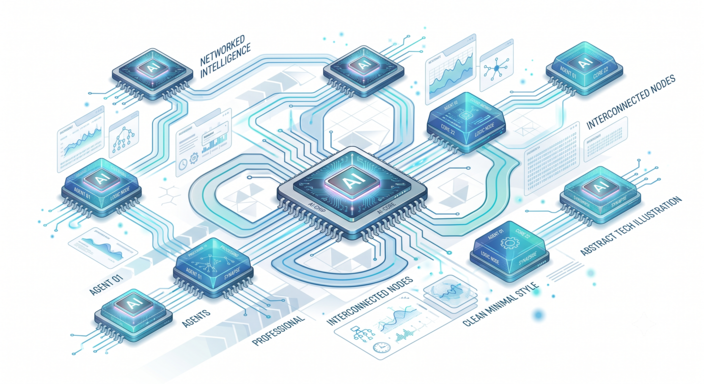
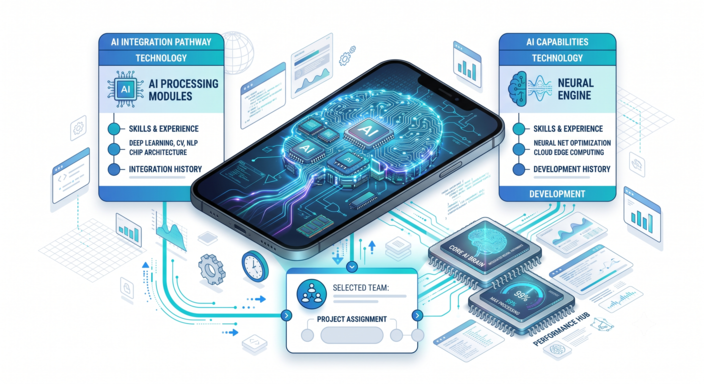

There are two ways to relate to artificial intelligence in software development. The first is to take an existing app and bolt on a chatbot, a semantic search feature, or a recommendation module. The second is to design the product from the start with AI as a central architectural component — not an accessory.
The difference between these approaches — known in the industry as the gap between “AI-enhanced” and “AI-native” software — is becoming one of the defining competitive differentiators between digital products in 2026. Apps built with AI integrated at their core learn, adapt and improve continuously. Those that add AI as a later layer, generally don’t.
What Exactly Is an AI-Native App
An AI-native application is one whose architecture has been designed from day one so that machine learning, data processing, and AI-based decision-making are integral to how it functions — not features added later.
- The database is designed to store and process training data from the very first user
- AI models are integrated into the app’s core flows, not peripheral modules
- The interface is designed for AI to improve user experience transparently and continuously
- Feedback loops (usage data, model improvement, better experience) are automated from launch
- The infrastructure supports data processing at scale from day one, without costly migrations later
AI-Native vs AI-Enhanced: The Differences That Matter
| Dimension | AI-Enhanced App | AI-Native App |
|---|---|---|
| Architecture | Built without AI, adapted later | Built with AI as a core component |
| Data quality | Historical data, often inconsistent | Structured for AI from day one |
| Continuous improvement | Manual, requires releases | Automatic, without intervention |
| Maintenance cost | High (integration technical debt) | Low (AI embedded in core flows) |
| User experience | AI visible as a “feature” | AI invisible, improves experience globally |
| Scalability | Limited by original architecture | Designed to scale with data |
Business Advantages in 2026
- +34% user retention in the first 90 days, thanks to personalised experiences from first use
- -28% churn in B2B SaaS products, as the AI learns customer patterns and delivers increasing value
- +45% iteration speed in the product team, as models update automatically without major releases
- 20% lower customer acquisition cost, because the product demonstrates personalised value within the first minutes of use
Real Examples by Sector
- Retail / ecommerce: the entire browsing experience built around a personalisation engine that learns from every interaction — not a “recommended products” widget bolted onto the sidebar
- Healthcare: health tracking apps that analyse user data patterns and adapt recommendations in real time, without the user configuring anything
- Fintech: financial management platforms that detect anomalies, predict behaviours and personalise dashboards automatically
- Logistics: route management apps that learn from past incidents and optimise proactively, not just reactively
- HR / Talent: hiring platforms that learn which candidates succeed in each type of role and automatically improve their filters
How to Build an AI-Native App From Scratch
- Define what problem AI solves: not “add AI” as a goal, but identify which decision or experience improves measurably
- Design the data strategy: what data to collect, how to store it, how to use it for model training or fine-tuning
- Choose the right technical architecture: vector databases, MLOps infrastructure, data pipelines, model APIs
- Integrate models into core flows, not optional modules
- Design the feedback loops: how usage data automatically feeds model improvement
This requires technical profiles with specific AI and machine learning experience — profiles that remain genuinely scarce in most markets. The most efficient alternative is working with external development teams already specialised in building these architectures. Spanish development teams, accessed through Yeeply, offer that expertise at a cost 40–50% lower than equivalent UK-based hires, with the quality standards and communication norms of a European team.
Conclusion: The Window of Opportunity
In 2026, there is still time to build an AI-native product and differentiate from competitors bolting AI onto their existing apps. But that window won’t stay open indefinitely: in 12–18 months, AI-native products will be the baseline expectation, not the differentiator.
If you’re planning a new digital product or a significant new version of your existing app, now is the moment to evaluate whether it makes sense to build it with AI-native architecture from day one. Yeeply can help you map that path and connect you with the right technical team to execute it.
Click “Request a quote” at the top right of yeeply.com/en or write to sales@yeeply.com.
Tags
Related posts
Multi-Agent AI: How Companies Are Shipping Software 3x Faster in 2026
Discover how multi-agent AI systems work and how companies use them to develop apps faster, with fewer errors and lower costs in 2026.

How Much Does It Cost to Maintain an App After Launch? Servers, Updates and Support Explained
Launching an app is not the end of the project — in many ways, it is just the beginning. Once an application is available on ...

Native App, Hybrid App or Web App: Which One Should You Choose in 2026?
When a company decides to build a mobile application, one of the first major decisions is choosing the right type of app architecture. In most ...

What an App Needs to Start Generating Revenue
Can an app generate revenue from day one? Yes — but only if it has been designed with business goals in mind from the very ...

Why Apps Work but Don’t Drive Business
Index Why can an app work technically and still fail to drive business? Because an app not crashing or having bugs doesn’t mean it’s creating ...
10 Best Software for Android App Development: Top Picks for 2024
Developing mobile apps can be a challenging task, especially when it comes to choosing the right tools. Knowing the best software options for Android app ...

Android App Development Services: Boost Your Mobile Strategy Today
Looking to create a standout application for the Android platform? Android app development services are the go-to solution for businesses and individuals aiming to design, ...
Top 10 Android App Development Agencies: Leading Innovators of 2024
Choosing the right agency for your Android app development is crucial for your success. In today’s fast-paced digital landscape, having a robust and user-friendly Android ...
Deep linking in Android and iOS applications
In the last months, we have been talking about internal links. And although they’ve been in the app world for a long time, and much ...
Mobile App Security: Definition, Key Features, Tools & Tips
In the digital era, where mobile applications are everywhere, mobile app security is probably one of the most critical topics in the mobile industry. As ...