In 2026, the term “AI agent” has moved from hype to operational reality. According to Gartner, 40% of enterprise applications will incorporate purpose-built AI agents before the end of this year — up from less than 5% in 2025. And within that shift, multi-agent systems are the biggest accelerator of software development across companies of all sizes.
What exactly are they? How do they work in practice? And how can a mid-sized business — without an in-house AI department — use them to ship software faster and at lower cost? This article explains it from the ground up, with real examples and without unnecessary jargon.
What Is an AI Agent (and Why It’s Not a Chatbot)
A chatbot answers questions. An AI agent executes tasks. That difference — seemingly small — changes everything.
An AI agent is a system that can perceive its environment, make decisions, and execute actions autonomously to reach an objective. It doesn’t just generate text: it can access databases, run code, call external APIs, query documentation, and coordinate with other systems — all without continuous human intervention.
While a chatbot needs you to specify every step, an AI agent receives a goal — “analyse all production errors from the last month and propose fixes” — and resolves it autonomously using the tools at its disposal.
What Are Multi-Agent AI Systems
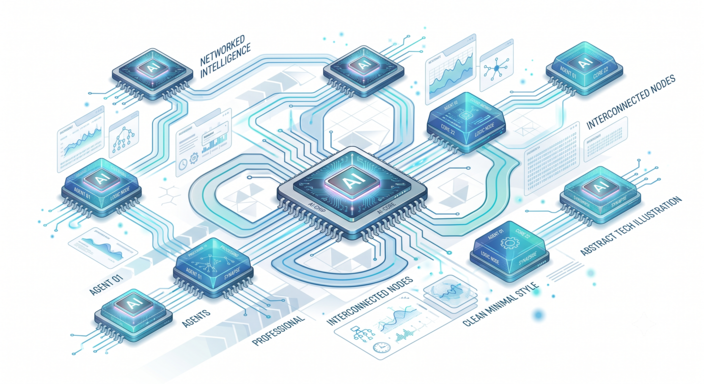
A multi-agent system is exactly what it sounds like: multiple AI agents working together, each specialised in a specific task, coordinating to complete a complex process.
Imagine developing a new feature for your app. In a multi-agent system, you might have:
Requirements analysis agent: processes the brief and converts it into structured technical specifications
Architecture agent: proposes the code structure and required dependencies
Development agent: writes the code following the specifications
Testing agent: generates and runs automated tests, detects bugs
Security review agent: scans the code for vulnerabilities
These agents work in parallel or sequentially, passing information between each other, with no human needing to coordinate them at every step. The result: significantly shorter development cycles and fewer human errors.
“Companies executing software projects with multi-agent systems in 2026 are reducing development times by 30–50% on standard features,” notes a Belitsoft report published in April 2026.
How They Work in Software Development
Orchestration: a coordinator agent receives the objective and breaks it down into subtasks assigned to specialised agents
Inter-agent communication: agents pass results between each other, validating and enriching information at each step
Human checkpoints: at critical points, the human team validates results before continuing
Delivery: the system consolidates all outputs into a final result ready for review or deployment
Real Use Cases in Companies
Use Case
Agents Involved
Measured Benefit
REST API generation
Analysis + Development + Testing
-60% development time
Database migration
Analysis + Transformation + Validation
-70% migration errors
Legacy code review
Audit + Refactoring + Documentation
-40% technical debt in 3 months
Automated test generation
Analysis + Testing + Reporting
+80% test coverage
Benefits and Risks to Consider
Speed: agents work 24/7, in parallel, without breaks
Consistency: they follow the same rules every time, without variation due to fatigue
Scalability: adding more capacity is a configuration matter, not a hiring matter
Cascading hallucinations: if one agent makes an unchecked error, it propagates downstream
Security: agents with access to production systems require strict permission policies
How to Get Started Without an In-House AI Team
Designing, implementing and maintaining agentic architectures requires specialised technical profiles that are scarce — and expensive — in most markets. In the UK, for instance, a senior AI engineer currently commands £80,000–£120,000 per year in salary alone, before factoring in recruiting costs, onboarding and retention.
The solution that an increasing number of companies are adopting: work with external development teams based in Spain that already have experience building these architectures. Yeeply connects UK and European companies with Spanish technical teams who have been building AI agent solutions for clients across multiple sectors for months. The cost is significantly lower than building an internal team from scratch, and time-to-start shrinks from months to weeks.
If you want to explore how multi-agent systems could apply to your specific project, click “Request a quote” at the top right of yeeply.com/en or write to sales@yeeply.com.
An MVP in 6 weeks is achievable — if you know what to put in it. This guide covers the phases, what to cut, realistic costs, and how to measure whether it worked.
AI agents in software development do real, concrete things — and have real, concrete limits. Here's an honest breakdown of what they handle today and what still needs a human developer.
Building an enterprise app without burning your budget starts long before the first line of code. A step-by-step guide to phases, common mistakes, and managing the project without technical expertise.
What AI-native software is, how it differs from adding AI to an existing app, and why companies that build it from day one gain a competitive edge in 2026.
Developing mobile apps can be a challenging task, especially when it comes to choosing the right tools. Knowing the best software options for Android app ...
Looking to create a standout application for the Android platform? Android app development services are the go-to solution for businesses and individuals aiming to design, ...