


AI agent development for businesses
An AI agent carries out whole tasks on its own: it reads an email, checks the ERP, updates the CRM, replies to the customer and only hands you what it can't resolve. At Yeeply we find the certified company that best fits your case and oversee the build until the agent is running in production on your data.
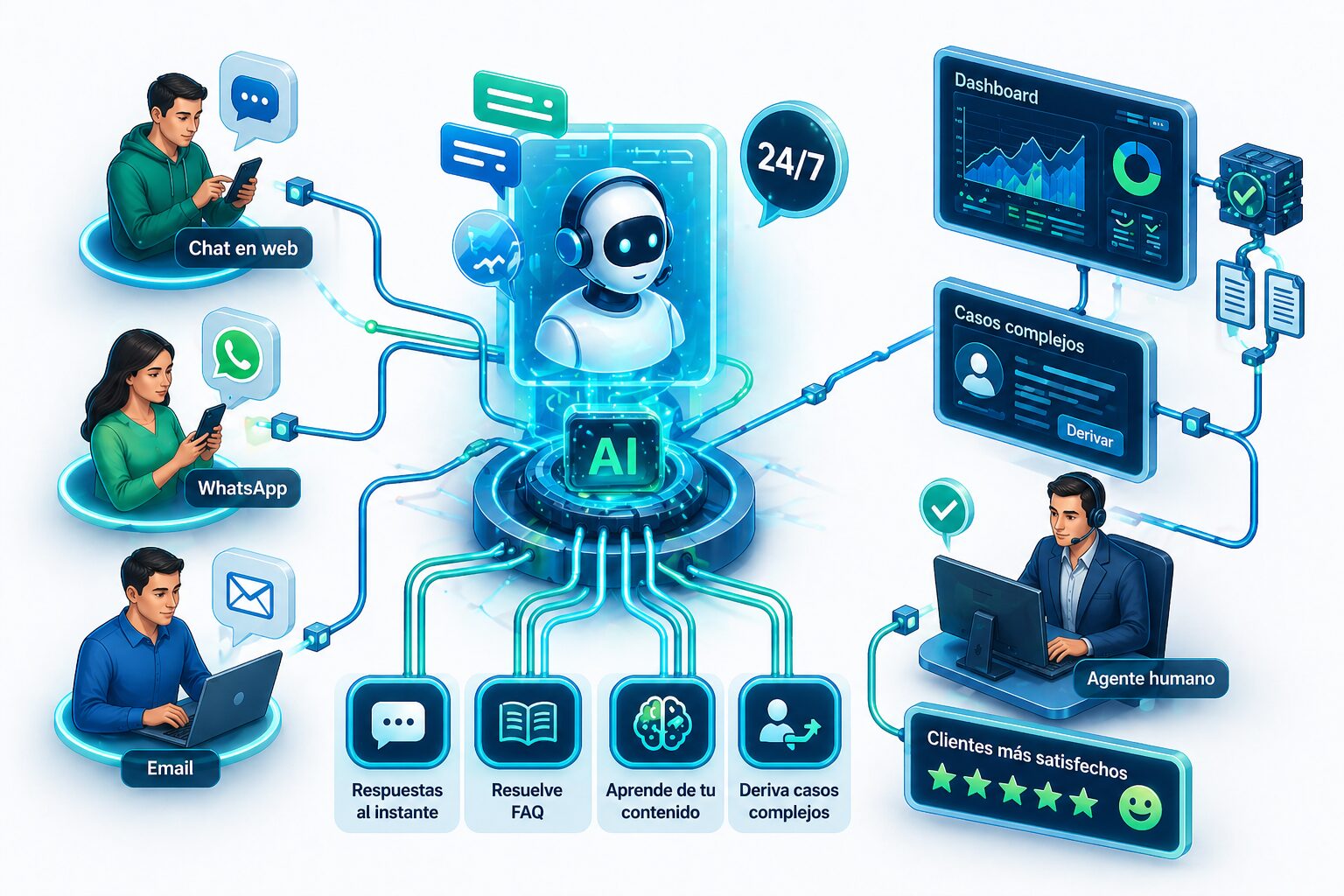
What an AI agent is and how it differs from a chatbot
The difference is that an agent takes action. It has access to tools (the APIs of your CRM, ERP, email or database), plans the steps needed to complete a job and carries them out, logging each one. AI agent development is about giving it that access with only the permissions it needs, and teaching it when to stop and ask.
Chatbot
Holds a conversation and answers with the information it has. It doesn't touch your systems. Useful for FAQs and first contact.
Rule-based automation (RPA)
Repeats the same steps every time. Very reliable when the process never changes, but it breaks at the first exception or when a document turns up in a different format.
AI agent
Understands the job, decides on the steps and uses your tools to get it done. It copes with the variation that rules can't cover and passes anything it shouldn't decide alone to a person.
What an AI agent can do for your business
These are the cases we see most often in real projects. In almost all of them the agent starts with a narrow task and takes on more once its accuracy has been measured.
Answers with real data
Checks an order's status, handles a return or moves an appointment without anyone stepping in. For online shops we build it as an ecommerce chatbot.
Takes calls
A voice agent picks up the phone at any hour, understands what the caller wants and passes complex cases on. More on AI phone answering.
Qualifies leads and follows up
Screens incoming leads, fills in the CRM record, suggests a meeting and picks the conversation back up with anyone who stopped replying.
Processes documents
Reads invoices, delivery notes and orders, matches them against the ERP and prepares the journal entry or quote for someone to approve.
Answers from your documents
Answers staff questions using only the company's manuals, contracts and procedures, and cites the source of every answer.
Inside your app or SaaS
The agent becomes part of the product you sell to your customers. We handle this together with AI app development.
How we develop your AI agent
An agent that works in a demo and one that works with your customers are two different projects. What separates them is testing on real cases and the limits the agent is given.
Discovery
One or two weeks to understand the process, the data available, what the agent is allowed to decide and how success will be measured.
Certified company
We bring you proposals from companies in our network that have worked on similar cases. You choose.
Prototype on your data
Within three to six weeks the agent is working through real cases from your history, and we measure how often it gets them right.
Integration and controls
Minimum permissions, a log of every action and human review for sensitive decisions.
Production and improvement
Tracking cost per task, errors and what gets passed to people, so the agent can be adjusted over time.
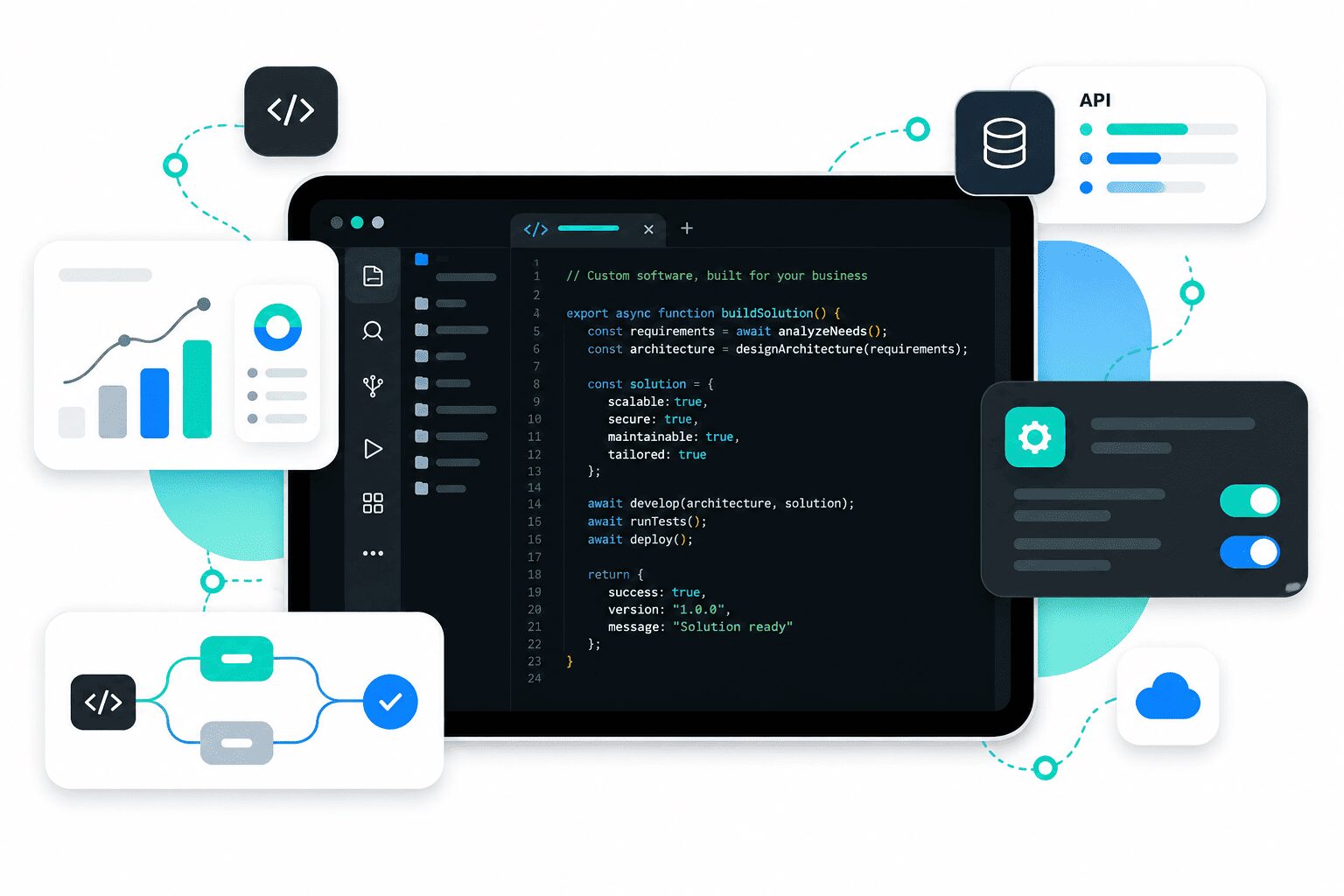
Connected to the tools you already use
An agent is only as useful as the systems it can reach. That's why most of the work goes into the integrations and into deciding what it can read and what it can change in each one.
- CRM: HubSpot, Salesforce, Pipedrive, Zoho
- ERP: Odoo, SAP Business One, Microsoft Dynamics, Holded
- Email and documents: Google Workspace and Microsoft 365
- Channels: web, WhatsApp Business, email and phone
- Models: OpenAI, Anthropic, Google or open models in your own cloud
How much does it cost to develop an AI agent?
The price depends mainly on how much autonomy the agent has, how many systems it connects to and how much volume it will handle. These are the ranges we see in the European market.
| Type of agent | What it includes | Development | Maintenance and usage |
|---|---|---|---|
| Single-task agent | One well-defined use case and one or two integrations | €8,000–25,000 excl. VAT | €500–1,000/month |
| Mid-complexity agent | Several related tasks and two or three internal systems | €25,000–60,000 excl. VAT | €1,000–2,000/month |
| Multi-agent system | Several coordinated agents, many integrations and high reliability requirements | €60,000–150,000+ excl. VAT | from €2,000/month |
Indicative market ranges. The fixed price is set by the selected company in its proposal, once it knows your case.
To work out the cost of your own agent, answer a few questions: the calculator gives you a range, excluding VAT.
An agent that acts needs limits
The more autonomy an agent has, the more its controls matter. Every project sets out what it can do on its own, what needs approval and how its work is reviewed.
- Minimum permissions in each system, never administrator access
- A log of every action, including the information it used to decide
- Human review of payments, contracts and decisions affecting people
- A clear notice when the customer is talking to an AI, as the EU AI Act requires
The transparency obligations in Regulation (EU) 2024/1689 already apply. If you'd like to review the AI your company already uses, our AI Act compliance service includes a free test.
AI agents: frequently asked questions
How long does it take to develop an AI agent?
An agent focused on a single task is usually in production within six to twelve weeks, including discovery, the prototype on real data and testing. If it works across several internal systems or involves several coordinated agents, three to six months is typical.
What's the difference between an AI agent and a chatbot?
A chatbot talks and answers. An agent also does things: it looks up an order in the ERP, creates an opportunity in the CRM, generates a document or books an appointment, and decides what order to do them in. Many projects start as a chatbot and become an agent once it's given access to the company's tools.
Does my data leave the company?
That depends on the design, and it's one of the first decisions in the project. You can use commercial models on European servers, under contracts that rule out using your data for training, or open models deployed on your own infrastructure when the information is especially sensitive.
Which AI model do you use?
Whichever suits the case best. The usual approach is to compare models from OpenAI, Anthropic and Google, plus open models such as Llama or Mistral, on accuracy, cost per task, latency and privacy. The agent is built so that switching models later doesn't mean rebuilding it.
What happens if the agent gets something wrong?
That's why it's designed with limits: minimum permissions on each system, a log of every action and human review for decisions that have a financial impact or affect people. Before it goes into production, it's tested on real cases from your history to measure how often it gets things right.
Who builds the agent?
One of the 150+ certified technology companies in our network, chosen because it has already solved similar problems. We bring you several proposals to compare and, once you choose, Yeeply oversees the build and is your single point of contact through to delivery.
You might also be interested in
Got a process in mind?
Tell us what task you want the agent to handle and which systems it works with. We'll get back to you within 24 hours with the next steps.