


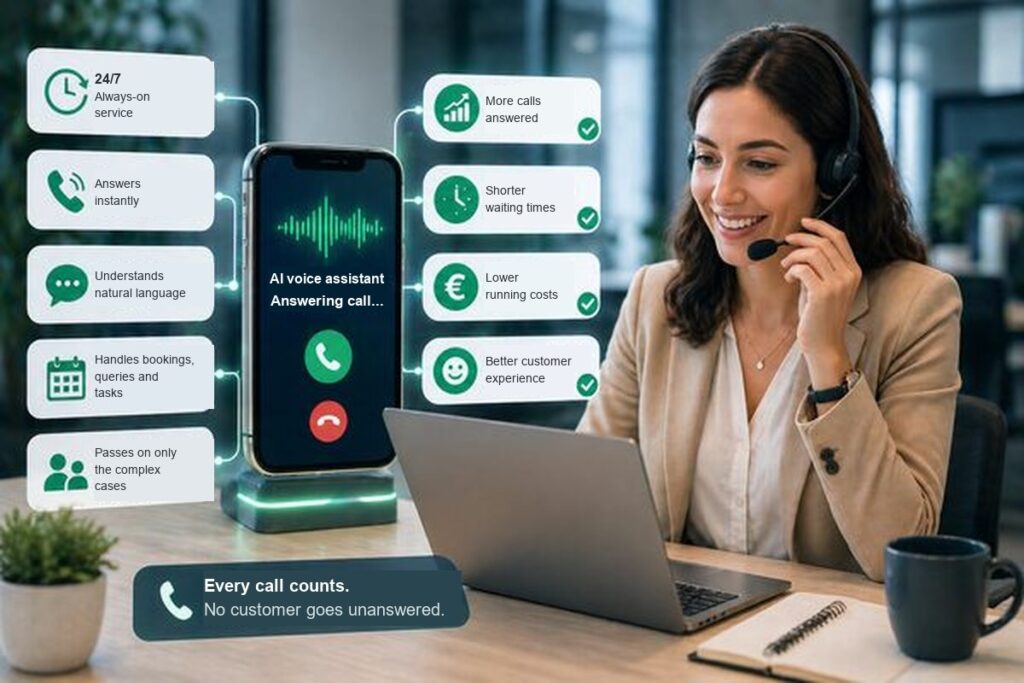
AI phone answering: what a voice agent handles
An AI voice agent picks up on the first ring, understands what callers want when they speak normally, and deals with the requests that come in every day. AI phone answering doesn't replace your staff: it takes the routine calls off their hands and passes on the ones that need a person, with the context already captured.
- Book, change and cancel appointments in your calendar
- Give opening hours, prices and the status of an order or repair
- Take details and log tickets in your CRM
- Answer out of hours and during call peaks
- Put callers through to the right person with a summary of the call

How an AI-answered call works
Picks up
The agent introduces itself as a virtual assistant and asks how it can help.
Understands
It transcribes what the caller says and works out what they want, however they phrase it.
Checks
It looks things up in the calendar, the CRM or the order system, so the answer is based on real data.
Resolves or transfers
It completes the request or hands the call to a person, together with the summary.
Logs
It records the call in your CRM with the transcript and the outcome.
How much it costs to automate phone answering with AI
The price depends on how many requests the agent handles on its own and how many systems it connects to. Indicative market ranges:
| Type of voice agent | What it includes | Build |
|---|---|---|
| Information | Opening hours, FAQs, taking details and transferring calls | €6,000–15,000 |
| Transactional | Appointments, order status and tickets, connected to your calendar and CRM | €15,000–35,000 |
| High volume | Several languages, phone system integration and multiple call flows | from €35,000 |
Indicative market ranges, excluding the per-minute usage cost. The fixed price is set by the selected certified company in its proposal.
To price your own case, answer a few questions: the calculator gives you a range, excluding VAT.
AI phone answering: frequently asked questions
Does the caller know they're talking to an AI?
Yes, and they have to. The EU AI Act requires people to be told when they are interacting with an AI system, so the agent introduces itself as a virtual assistant when it picks up. There's more detail on our AI Act compliance page.
Do I need to change my number or phone system?
Usually not. The agent connects to your existing phone system or takes calls diverted from your number, either all the time, out of hours or when every line is busy.
What happens to calls it can't handle?
It transfers them to a member of your staff with a summary of what the caller asked for. If nobody is available, it takes a message, logs a ticket in your CRM and schedules a call back.
Does it understand accents and speak other languages?
Current voice models handle regional accents well and can answer in English, French, Spanish, German or other languages on the same line, detecting which language the caller is using.
How much does each minute of call time cost?
On top of the build, usage is charged per minute: voice, transcription and the language model usually add up to between €0.05 and €0.20 per minute, depending on the provider and volume. That gives you a figure to compare with the real cost of each call answered by a person.