What AI governance actually means in a software context
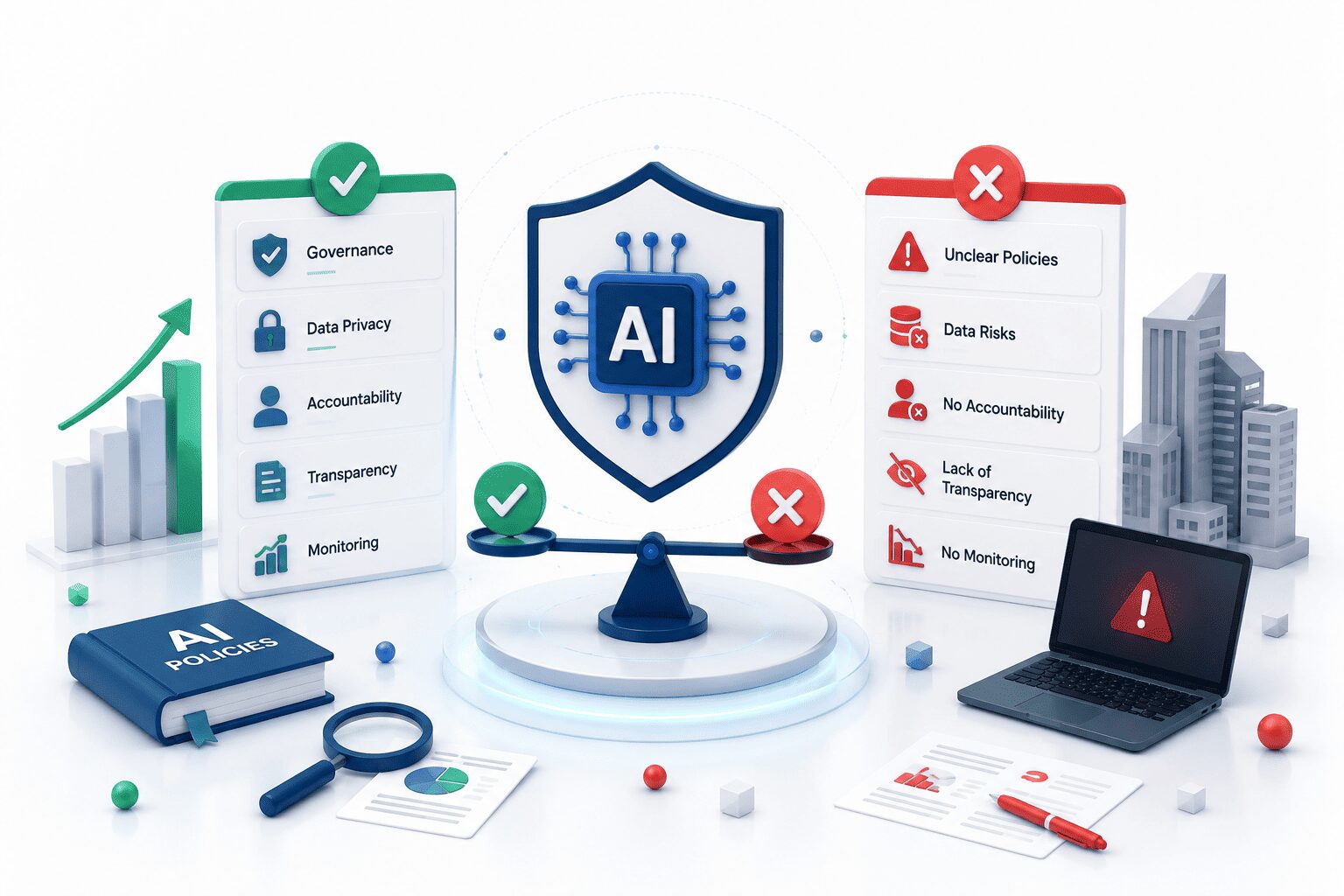
AI governance is the set of policies, processes, and technical controls that determine how AI systems are built, tested, deployed, and monitored within an organisation. It’s distinct from AI ethics as a general concept — governance is operational: who approves an AI system for production, what testing it needs to pass, how its outputs are monitored, and what happens when it goes wrong.
For UK enterprises in 2026, AI governance has moved from a nice-to-have to a requirement. The EU AI Act affects UK companies that sell into EU markets. The UK’s pro-innovation AI regulatory framework places responsibility on individual sector regulators, which means financial services companies face FCA expectations, healthcare companies face MHRA guidance, and so on. And the ICO has been clear that AI systems processing personal data carry GDPR obligations that don’t disappear because the decision-maker is an algorithm.
What UK enterprises are getting right
The companies managing AI governance well in 2026 share a few consistent practices.
They treat AI systems like any other production software. The best-governed AI deployments don’t have separate AI governance processes — they have good software development processes that include AI-specific checkpoints. Code review includes reviewing prompts and model configurations. Testing includes adversarial testing for AI components. Deployment includes monitoring for model drift.
They document the decisions, not just the outputs. When an AI system makes a decision — a loan approval, a content recommendation, a risk score — the governance requirement is to be able to explain why. Companies that log the inputs, the model version, and the decision rule at each inference point can reconstruct that explanation. Companies that only log the output can’t.
They define accountability before deployment. In well-governed organisations, there is a named person or team responsible for each AI system in production. That person owns the monitoring, the escalation process when the system misbehaves, and the decision to take it offline if necessary. In poorly governed organisations, nobody owns the AI system — which means nobody notices when it starts behaving unexpectedly.
What they consistently get wrong
Treating governance as a pre-launch checklist. The most common failure mode is approving an AI system before deployment and then not revisiting it. AI models behave differently as data distributions shift, as user behaviour changes, and as the world changes. A system that was appropriately accurate in January may not be in September. Governance requires ongoing monitoring, not one-time sign-off.
Not distinguishing between AI risk levels. An AI system that recommends which blog posts to show is not the same risk as an AI system that approves credit applications or flags suspicious transactions. Many companies apply the same (usually too-light) governance process to both. The EU AI Act’s risk tiers are a useful framework here even for UK companies not directly subject to it — the categories are logical.
Buying AI tools without reviewing their governance implications. Many enterprise AI tools — copilots, productivity assistants, customer service platforms — process internal company data or customer data. Procurement teams that didn’t have AI governance processes five years ago are now buying systems with significant data implications without the review processes to match. The contract review and data processing agreements that governance requires are often not happening.
The regulatory landscape UK companies need to track
- EU AI Act. In force from August 2024; prohibitions apply from February 2025, high-risk system requirements from August 2026. Relevant if you sell software or services into the EU or use AI systems in scope of the regulation.
- UK AI regulatory framework. No single AI Act equivalent; sector regulators apply existing rules to AI. FCA, PRA, MHRA, ICO, and Ofcom have all published AI guidance relevant to their sectors.
- ICO guidance on AI and data protection. AI systems processing personal data must comply with GDPR/UK GDPR. The ICO’s AI and data protection guidance covers lawful basis, transparency, automated decision-making, and data minimisation in AI contexts.
- NIST AI Risk Management Framework. A US framework increasingly referenced by UK enterprises as a practical governance structure, regardless of geography.
Practical governance steps for 2026
If you’re building AI into your software or deploying AI tools across your organisation, these are the governance steps that matter most right now:
- Inventory your AI systems — know what you’re running and who owns it
- Classify each system by risk level and document that classification
- Define monitoring thresholds and escalation paths for each production AI system
- Review data processing agreements for any third-party AI tools handling personal data
- Include AI components in your existing software development review and testing processes — don’t create parallel tracks
- Document the decisions your AI systems make in a way that can be reconstructed and explained
Good AI governance is largely good software engineering applied consistently. The companies that are ahead on this have not built elaborate new governance bureaucracies — they’ve extended their existing engineering discipline to include AI-specific considerations.
At Yeeply, we work with certified development teams in the UK who build AI systems with governance built in from the start — logging, monitoring, explainability, and audit trails as part of the architecture, not afterthoughts. For projects where budget is a factor, we also work with Spanish teams at 30–40% lower cost with equivalent technical depth. Request a quote from the top right of yeeply.com/en or write to sales@yeeply.com.