


RAG development services: AI that answers from your company's documents
A RAG system lets your team or your customers ask questions in plain language and get answers taken only from your manuals, contracts, policies and knowledge base, with the source of every answer. At Yeeply we find the certified company that best fits your case and oversee the build until it's running on your documents.
What RAG is and why ChatGPT on its own isn't enough
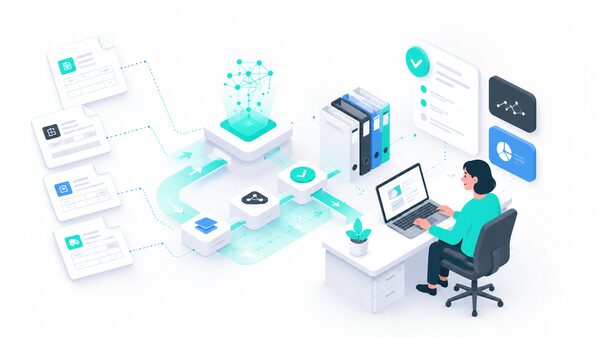
RAG stands for retrieval-augmented generation. Before the AI writes an answer, the system searches your documents, picks the passages that matter and hands them to the model with one instruction: answer using this and nothing else. RAG development is the work of connecting your sources, keeping them up to date and making sure each person only gets answers from what they're allowed to see.
A general chatbot
Answers from what it learned during training. It knows nothing about your prices, your procedures or last month's contract, and when it doesn't know, it can make things up.
Fine-tuning a model
Retrains the model with your data. Expensive, slow to update and it still can't tell you which document an answer came from. It suits tone and format better than facts.
RAG
Looks up the answer in your documents every time someone asks, so a change to a document shows up straight away. It cites the source and can say "I can't find that" instead of guessing.
What a RAG system can do for your company
These are the cases we see most. Most projects start with one team and one set of documents, and widen once people trust the answers.
Answers for the whole team
HR policies, procedures, product specs and onboarding material, available in one place instead of five shared drives and the one colleague who knows where everything is.
Self-service that doesn't guess
Customers get answers drawn from your help centre and manuals, and anything it can't answer goes to a person. For shops we build it as an ecommerce chatbot.
Faster replies for agents
Support staff see the relevant passage of the manual next to each ticket, with a draft reply they can check and send.
Search contracts and regulations
Find the clause, the deadline or the obligation across hundreds of contracts or case files, with a link to the exact page.
Proposals from what you've already written
Reuses past proposals, case studies and technical sheets to draft answers to tenders and RFPs in a fraction of the time.
Technical documentation on site
Technicians ask about a machine or an installation from their phone and get the answer from the manual, including drawings and scanned sheets.
How we build your RAG system
The model is the easy part. What decides whether people use it is the quality of the documents, the permissions and testing with real questions.
Document audit
Which sources, how many documents, what format they're in, how often they change and who can see each one.
Certified company
We bring you proposals from companies in our network that have built similar systems. You choose.
Ingestion and indexing
Extracting the text (including scans and tables), splitting it into passages and indexing it with its permissions.
Testing with real questions
A set of questions your team actually asks, with the right answers, to measure accuracy before launch.
Launch and monitoring
Tracking unanswered questions, wrong answers and cost per query, and keeping the index in sync with your documents.

Connected to where your documents already live
Nobody should have to move their files to a new tool. The system reads from the sources you already use, keeps their permissions and answers wherever your people already work.
- Sources: SharePoint, OneDrive, Google Drive, Confluence, Notion and document management systems
- Business data: CRM, ERP, help desk and internal databases
- Where people ask: Microsoft Teams, Slack, your intranet, your website or inside your own app
- Search: Azure AI Search, Elasticsearch, OpenSearch, pgvector or Pinecone
- Models: OpenAI, Anthropic, Google or open models in your own cloud
How much does a RAG system cost?
What drives the price is rarely the AI model. It's how many documents you have and how messy they are, how many places they live in and whether answers must respect who can see what. These are the ranges we see in the European market.
| Type of project | What it includes | Build | Running costs |
|---|---|---|---|
| Pilot | One team, one source, clean documents and a simple web interface | €5,000–15,000 excl. VAT | €150–600/month |
| Departmental system | Several sources, permissions by department, citations and Teams or Slack | €15,000–35,000 excl. VAT | €600–2,000/month |
| Company-wide system | Many sources, scanned documents, per-user permissions and sensitive data | €35,000–60,000+ excl. VAT | from €2,000/month |
Indicative market ranges. Running costs cover the AI model, search and hosting, and depend on how many questions are asked. The fixed price is set by the selected company in its proposal, once it knows your case.
Work out your own estimate
Ten questions about your documents, where they're stored and who needs to see them. It takes two minutes.
What makes people trust the answers
A RAG system that gets one answer badly wrong stops being used. These are the controls every project includes from the start.
- Each answer respects the permissions of the original document: nobody sees through the AI what they couldn't open in SharePoint
- The document, and the page where relevant, behind every answer
- "I can't find that in the documentation" when the answer isn't there
- Your data stays in European servers and is never used to train the model
- A clear notice when someone is talking to an AI, as the EU AI Act requires
One recent project in our network: a RAG system with a custom chatbot and role-based access, now used by a company's technical support and customer service teams to answer from their own documentation. If you'd like to review the AI your company already uses, our AI Act compliance service includes a free test.
RAG development: frequently asked questions
How long does it take to build a RAG system?
A pilot with one team and one source of clean documents is usually live in four to eight weeks. A system that spans several sources, respects per-user permissions and handles scanned documents takes three to five months. Permissions are what most often turn a short project into a long one.
What's the difference between RAG and fine-tuning?
Fine-tuning changes the model itself with your data, which is costly and has to be repeated every time your information changes. RAG leaves the model as it is and gives it the right passages from your documents at the moment of each question, so updates are immediate and every answer can cite its source. For answering questions about company information, RAG is almost always the better choice.
Will our documents be used to train the AI?
No. With business contracts from the main model providers your data is not used for training, and it can be processed on European servers. When the information is especially sensitive, the system can run on open models deployed in your own cloud, so nothing leaves your infrastructure.
Can a RAG system still make things up?
It's far less likely than with a general chatbot, because it only answers from the passages it finds and it's told to say so when it finds nothing. It isn't zero, which is why every project is tested against a set of real questions before launch and every answer shows its source so people can check it.
How does it stay up to date?
The system re-reads the sources on a schedule or as soon as a document changes, depending on how often your information moves. When someone updates a policy in SharePoint or Drive, the next answer already uses the new version.
Who builds the system?
One of the 150+ certified technology companies in our network, chosen because it has already built similar systems. We bring you several proposals to compare and, once you choose, Yeeply oversees the build and is your single point of contact through to delivery.
You might also be interested in
Got documents nobody can find?
Tell us what kind of documents you have, where they live and who needs answers from them. We'll get back to you within 24 hours with the next steps.