Home » Blog » Custom Software vs Off-the-Shelf ESG Platform: A Cost Comparison for UK SMEs

Custom Software vs Off-the-Shelf ESG Platform: A Cost Comparison for UK SMEs

Custom Software vs Off-the-Shelf ESG Platform: A Cost Comparison for UK SMEs

What off-the-shelf ESG platforms actually do

The ESG software market has grown significantly in the past three years. Platforms like Persefoni, Watershed, Sweep, Workiva, and Salesforce Net Zero Cloud now offer reasonably mature tools for emissions tracking, sustainability reporting, and regulatory disclosure.

What they do well: structured data entry for known emissions categories, pre-built frameworks for common reporting standards (GRI, TCFD, CSRD, and now UK SRS), dashboards, and audit trails. For companies whose operations fit the standard templates, they can get a reporting system live in weeks rather than months.

What they do less well: integrating with unusual or legacy internal systems, handling complex supply chain data from non-standard sources, and adapting to business models that don’t fit the standard emissions categories. The promise of “plug and play” ESG reporting usually meets the reality of your IT infrastructure somewhere in the implementation process.

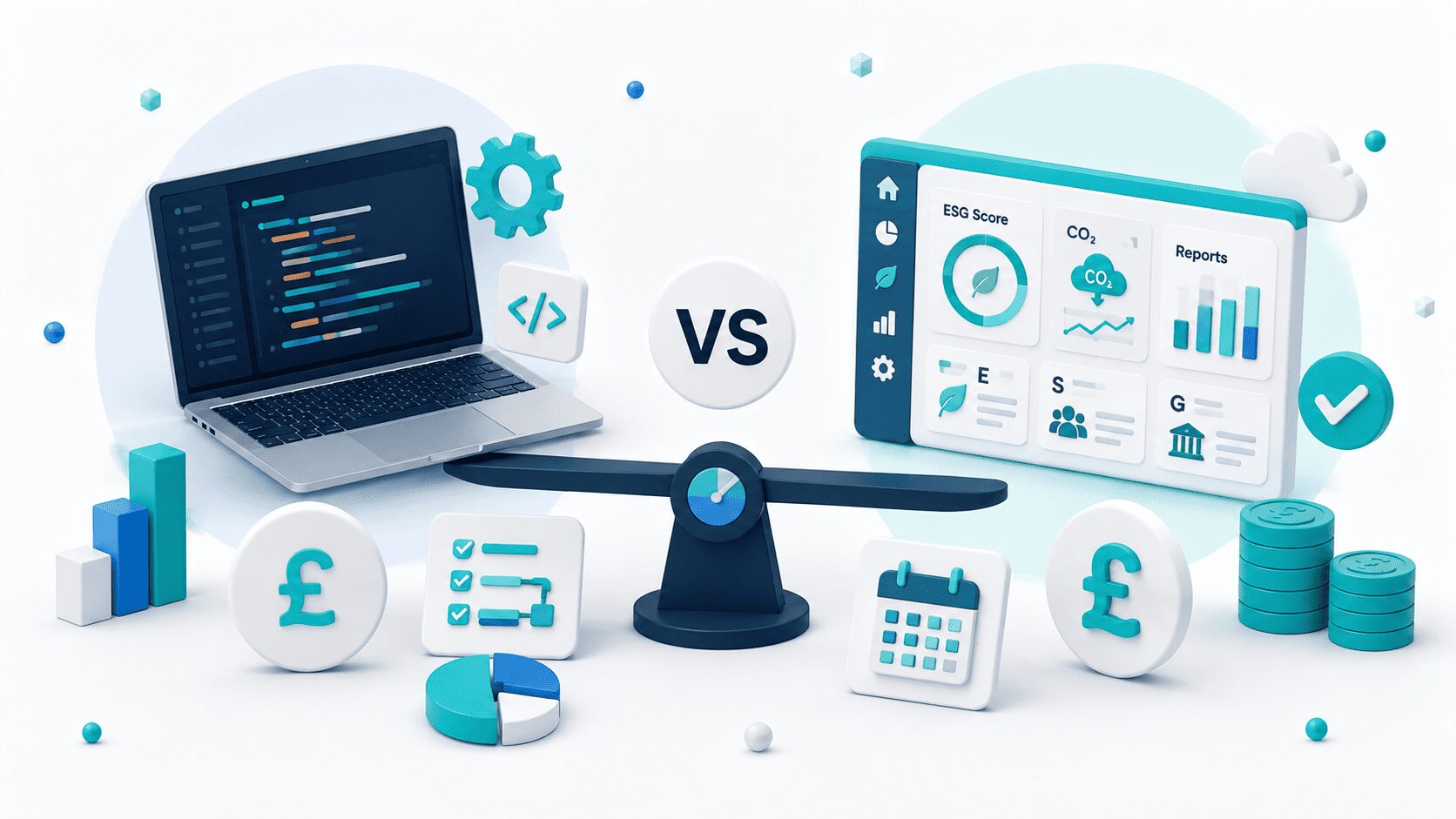
Cost comparison: platform licence vs custom build

Off-the-shelf ESG platformCustom-built ESG software
Initial cost£5,000 – £30,000 setup + implementation£40,000 – £150,000+ depending on scope
Annual licence / running cost£15,000 – £80,000/year (scales with company size)Hosting + maintenance: typically £5,000 – £20,000/year
Integration workOften underestimated; £10,000 – £50,000 in custom connectorsIncluded in initial build scope
Time to first report6-16 weeks4-8 months
Flexibility to changeLimited by vendor roadmapFull control
Ongoing dependencyHigh (vendor pricing, availability, roadmap)Low

The platform often looks cheaper upfront and more expensive over three to five years. The custom build looks expensive upfront and cheaper if your needs are stable and your team can maintain it. The integration work — which most platform vendors underquote — is where the real cost comparison shifts.

When custom software wins

Custom development makes more sense when the existing platforms can’t accommodate your situation. The most common cases:

  • Complex or proprietary supply chain data. If your Scope 3 emissions require data from non-standard sources — bespoke supplier systems, unusual product categories, complex logistics — off-the-shelf platforms struggle. A custom data pipeline handles this far better.
  • Multiple regulatory frameworks simultaneously. UK SRS, CSRD (if you have EU operations), GRI, and TCFD have overlapping but non-identical requirements. Most platforms handle one well. If you need all four, a custom layer that generates output for each is often more practical.
  • ESG data as a client-facing feature. If sustainability reporting is part of your product offering — something you show clients, not just regulators — you need design control that a white-labelled platform can’t give you.
  • Tight integration with core business systems. If emissions data needs to flow in real-time from your ERP, your logistics system, and your manufacturing software, the integration complexity often justifies building rather than buying.

When the platform wins

Off-the-shelf makes more sense when your operations are relatively standard and your primary goal is regulatory compliance rather than differentiation:

  • Your emissions profile fits standard categories (offices, business travel, purchased electricity)
  • You use common enterprise systems that the platform already integrates with
  • You need to be reporting within months, not quarters
  • You don’t have an internal team to maintain custom software
  • The regulatory landscape is still changing and you want the vendor to absorb framework updates

The hybrid approach most UK companies end up with

In practice, most mid-sized UK companies end up with a hybrid: an off-the-shelf platform for the reporting and disclosure layer, and custom development for the data integration work that feeds it. The platform handles the structured reporting templates and audit trails. The custom code handles the messy reality of pulling data from systems that were never designed to produce emissions data.

This hybrid tends to be more cost-effective than a full custom build and more reliable than assuming the platform’s built-in connectors will handle everything. The custom integration layer is usually a few months of development work — the part where using an experienced external team pays off most.

At Yeeply, we work with certified development teams across the UK who have built ESG data pipelines and integration layers for companies going through exactly this process — and for projects where budget is a constraint, we also work with Spanish teams at 30–40% lower cost with equivalent technical depth. Request a quote from the top right of yeeply.com/en or write to sales@yeeply.com.

Tags